

HDMI 2.1 features
What's new in HDMI 2.1? With the Playstation PS5 and Microsoft Xbox Series-X, the first HDMI 2.1 sources from consumer electronics were released in 2020. PC graphics cards can also...



Experience full HDMI 2.1 performance with up to 8K 60Hz on two displays simultaneously.
SP210 HDMI 2.1 Splitter 1 In 2 Out for 8K 60Hz and 4K 240Hz (DSC) with Downscaler is backordered and will ship as soon as it is back in stock.


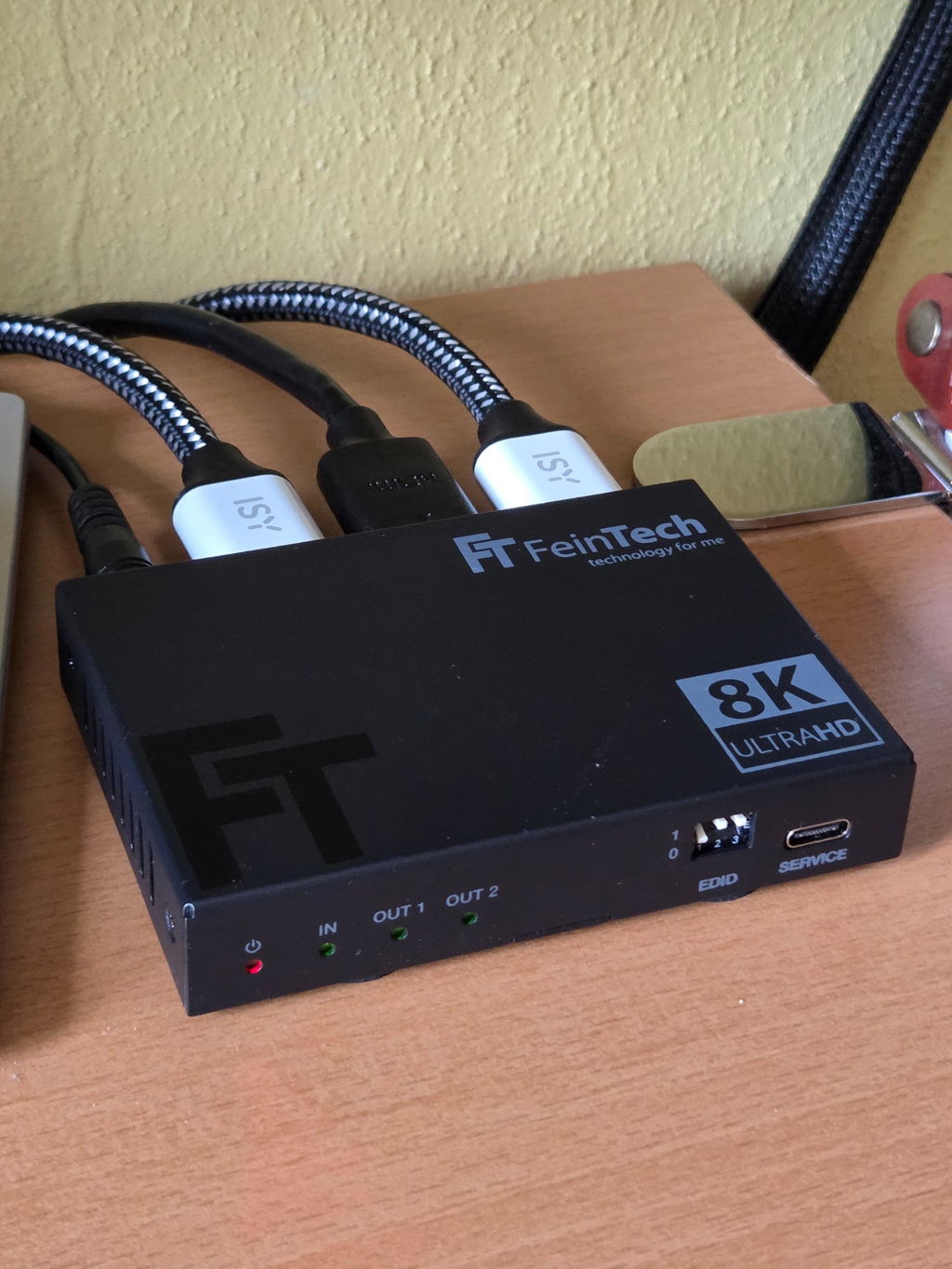
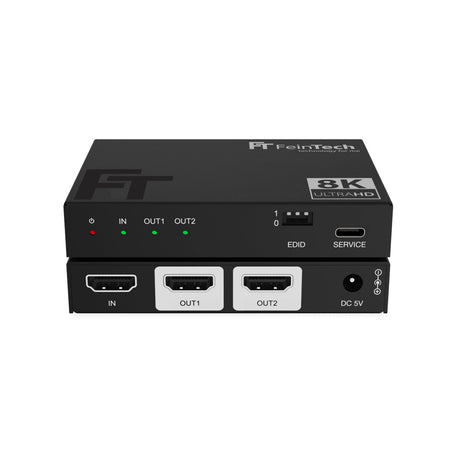
The SP210 HDMI 2.1 splitter simultaneously distributes the video and audio signal from one HDMI source to two HDMI devices. With the full HDMI 2.1 bandwidth of 48 Gbit/s, resolutions up to 8K 60Hz and 4K 240Hz with DSC, it is particularly suitable for demanding gaming, home cinema, and AV setups. The integrated downscaler also allows the simultaneous operation of displays with different resolutions. The extensive EDID management allows you to specifically determine which video and audio formats the player should output.
With the SP210, you can connect one HDMI source to two HDMI end devices simultaneously. For example, a gaming console, a gaming PC, a streaming box, or a Blu-ray player can be connected in parallel to two televisions, monitors, projectors, or other HDMI devices. The signal is simultaneously available at both HDMI outputs, eliminating the need to replug the HDMI connection.
Both displays generally show the same image content. When connecting a computer, the screen is therefore duplicated on both displays. An extended desktop with different image contents is not possible with the SP210.
The SP210 supports the maximum HDMI 2.1 data rate of 48 Gbit/s and is therefore designed for particularly demanding video formats. Resolutions up to 8K 60Hz are supported, as well as 4K with up to 240Hz thanks to DSC.
This makes the splitter particularly suitable for powerful gaming PCs, current game consoles, and high-quality home cinema systems. HDR10, HDR10+, HLG, and Dolby Vision are also supported.
In addition, HDMI 2.1 functions such as VRR, ALLM, QMS, QFT, and SBTM are passed through, provided that the HDMI source, the connected devices, and the HDMI cables used support the respective functions.
For particularly high resolutions and refresh rates, the SP210 supports Display Stream Compression, or DSC. This allows compatible HDMI devices to transmit video signals up to 4K 240Hz.
DSC must be supported by the HDMI source and the respective display. Without DSC, the maximum possible resolution and refresh rate depend on the HDMI signal format used and the available HDMI 2.1 bandwidth.
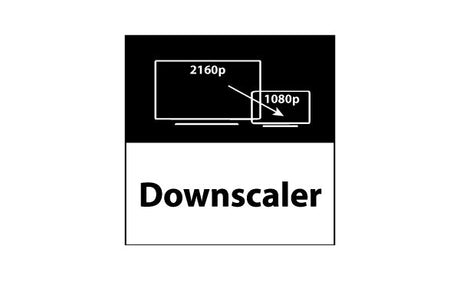
The integrated downscaler enables the simultaneous operation of displays with different maximum resolutions. For example, a 4K signal can be maintained on a compatible 4K television, while the SP210 automatically reduces the resolution for a connected Full HD projector to 1080p.
8K signals can also be downscaled to 4K or Full HD for displays with lower resolutions. The downscaler supports scaling from 7680 x 4320 to 3840 x 2160 or 1920 x 1080, and from 3840 x 2160 to 1920 x 1080. Other resolutions or DSC compressed signals are not scaled.
The refresh rate is not changed during downscaling. For example, 4K 120Hz becomes 1080p 120Hz, not 1080p 60Hz. HDR, color, and audio formats are also not fundamentally adjusted by downscaling. The connected display must therefore support the output refresh rate and the other signal formats.
For an HDMI source to output the appropriate video and audio signal, it receives information about the capabilities of the connected devices via EDID. The SP210 offers extensive EDID management for this, allowing the signal output to be specifically tailored to the respective setup.
Eight EDID configurations are available via three DIP switches. In addition to taking over the EDID data from HDMI OUT1, you can specifically define certain video and audio properties. For example, 4K 60Hz or 8K HDR as well as different audio formats can be set.
These extended setting options are particularly practical in demanding setups where the HDMI source does not automatically select the desired signal format.
| Dip | Video | Audio |
|---|---|---|
| 111 | COPY* | COPY* (recommended) |
| 001 | COPY* | Audio 5.1 DTS/Dolby/PCM 2.0 |
| 000 | COPY* | Audio 7.1 DTS/Dolby/HD/PCM7.1 |
| 110 | 4K 60Hz 4:4:4 | Audio PCM 2.0 |
| 101 | FRL12G 8K HDR | Audio PCM 2.0 |
| 100 | FRL12G 8K HDR | Audio 5.1 DTS/Dolby/PCM 2.0 |
| 011 | FRL12G 8K HDR | Audio 7.1 DTS/Dolby/HD/PCM7.1 |
| 010 | FRL12G 8K Dolby Vision | Audio 7.1 DTS/Dolby/HD/PCM7.1 |
*COPY means that the EDID data of the connected display 1 is adopted.
FRL12G enables a maximum data rate of 48 Gbps (HDMI 2.1 Maximum)
In addition to the video signal, the SP210 also transmits modern multi-channel audio formats such as Dolby Atmos, Dolby TrueHD, Dolby Digital Plus, Dolby MAT, DTS:X, DTS-HD, DSD, and LPCM up to 7.1.
Via EDID management, you can influence which audio capabilities are reported to the HDMI source. This allows you to configure the audio output to match the connected devices and your AV setup.
The SP210 supports the passthrough of HDMI-CEC between the HDMI input and HDMI OUT1. This allows compatible devices to exchange CEC control commands via the HDMI connection, for example, for shared power on/off or for controlling a player with the TV remote control.
CEC communication takes place exclusively via HDMI OUT1. Which CEC functions are actually available depends on the connected devices.
Please note:
ARC and eARC are not supported by the SP210. Therefore, the splitter is not suitable for passing TV audio via the audio return channel to a soundbar or AV receiver. If the HDMI signal is to be additionally output to an audio system, an HDMI audio extractor may be a more suitable solution depending on the application.
When using with a computer, please note:
Compare our HDMI splitters
| Facet | |||||
|---|---|---|---|---|---|
| Price | |||||
| Price |
Regular price
€69,99
Unit price
|
Regular price
€89,99
Unit price
|
Regular price
€59,99
Unit price
|
Regular price
€39,99
Unit price
|
Regular price
€59,99
Unit price
|
| Rating | |||||
| Rating | - | ||||
| HDMI version | |||||
| HDMI version | |||||
| HDMI inputs | |||||
| HDMI inputs | - | - | - | - | - |
| HDMI outputs | |||||
| HDMI outputs | |||||
| Video resolution | |||||
| Video resolution | - | - | - | - | - |
| HDMI-CEC control | |||||
| HDMI-CEC control | |||||
| Supported gaming formats | |||||
| Supported gaming formats | - | - | - | - | - |
| Edid Management | |||||
| Edid Management | |||||
| HDMI ARC from TV | |||||
| HDMI ARC from TV | |||||
| Compatible HDCP | |||||
| Compatible HDCP | |||||
What's new in HDMI 2.1? With the Playstation PS5 and Microsoft Xbox Series-X, the first HDMI 2.1 sources from consumer electronics were released in 2020. PC graphics cards can also...
How does a downscaler work in an HDMI splitter and what are the advantages? In the world of home theater technology and professional audio-video applications, HDMI splitters are widely used...

We often get asked which HDMI splitter can be used to connect two monitors to one PC simultaneously. In principle, this works with any of our HDMI splitters or HDMI...
Dieser HDMI 2.1-Splitter teilt Signale effektiv auf mehrere Displays mit 4K 120 Hz und 8K 60 Hz auf. Kunden sagten, es „funktioniert wie angekündigt“ und lobten seine Zuverlässigkeit bei Spielekonsolen wie Xbox Series X und PS5 Pro. Ein Kunde stellte eine geringere Latenz beim Spielen fest. In den Testberichten wird der hervorragende Kundensupport und die hochwertige Verarbeitung hervorgehoben. Erfolgreiche Setups wurden mit langen Kabeln ohne Ausfälle durchgeführt.
Bereits vor etwas mehr als einem Jahr habe ich einen Weg gesucht um meine HDMI 2.0 Soundbar und meinen HDMI 2.1 Monitor gleichzeitig mit der Xbox Series X zu betreiben. Damals habe ich den AX211 gekauft, der seine Aufgabe problemlos erfüllt hat. Jetzt habe ich aber auch noch einen Fernseher, der ein HDMI-Signal braucht.
Daraufhin habe ich mich nocheinmal hier umgeschaut und zunächst den SW211 bestellt. Dieser hat für mich leider nicht funktioniert, da die Gesamtkabellänge und Datenrate scheinbar zu groß war. Der Service von FeinTech war aber ausgezeichnet, sodass ich den SW211 problemlos zurückschicken konnte.
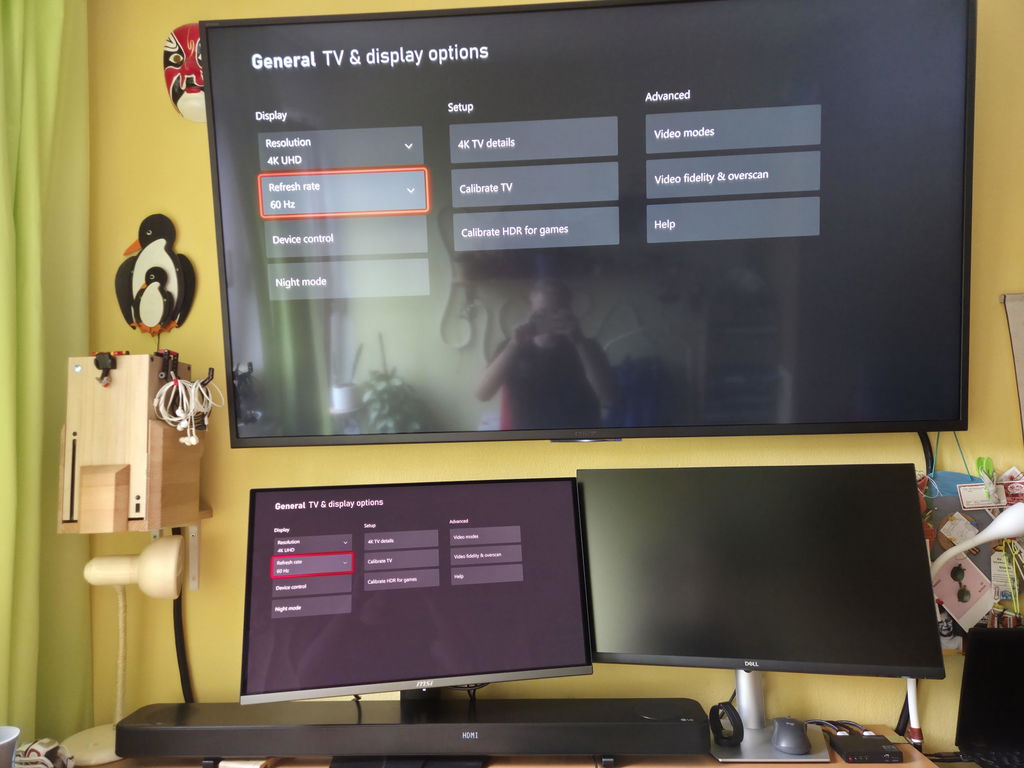
Daher habe ich nun den SP210 bestellt und er funktioniert soweit ohne Probleme. Am Input hängt die Xbox, an Out 1 der Monitor, an Out 2 die Soundbar. Am HDMI-Output der Soundbar hängt der Fernseher. Zwischen der Xbox und dem Monitor liegen etwa 4,5m und 9m zwischen dem Fernseher und der Xbox. Das ganze System funktioniert ohne jegliche Bildausfälle. Der Monitor läuft bei 4k 120Hz und der Fehrnseher bei 4k 60Hz.
Feintech SP210 is the first device I've tried (and I tried a few) that actually delivers 4K 120Hz on PS5 Pro without issues.
Customer support was also excellent, very helpful before purchase
funktioniert wie es soll, gerne wieder
.
Eine ganz feine Kiste, die eine Playstation 5 Pro mit einem 8kTV und einem 4kTV verbindet. Der Frieden im Wohnzimmer ist durch diese kleine aber feine Kiste gesichert. Und ich muss nicht aufstehen zum Umstecken.
Sehr gutes Gerät
Mit diesem Gerät habe ich die Latenzzeit zum gamen um fast die hälfte verringert, da ich sogar 2 weitere Ketten habe, von Konsole zum Fernseher. Läuft verständlicher weise nicht simultan, aber den Fernseher kann man ja auf stumm stellen, deswegen den 1 Stern abzug.
Schnelle Lieferung, hochwertiges Produkt
I want to use this for my xbox series x with 4k 120hz to my main display and 4k 60hz to my secondary. Is this possible? I dont understand the graph because I dont want 1080p 120hz on the secondary
It is correct that you see 1080p 120Hz in the graphic. If your Xbox is set to 4K 120Hz resolution, there is no output in 4K 60Hz at the same time for a second display. The splitter can only downscale the video signal to 1080p resolution and keep the 120Hz frame rate. This will ensure a smooth picture on the second display. Frame skipping would look terrible. Recalculating the video signal would also require more powerful hardware and result in a delay.
What is the recommended cable length for 4K 120hz output on two monitors?
The recommended maximum cable length for a passive HDMI cable is 3 m (@4K 120Hz). A longer distance can be achieved using a ProAqtive active HDMI cable.
Does it support 4K 240Hz for dual output?
Yes, with DSC (Display Stream Compression) enabled, 4K @ 240Hz can be supported.
Please note that both your source and displays must support DSC, and the same signal will be mirrored on both outputs.
Hello,
I have to ask you for a splitter in your catalog that best suit my configuration.
I have to split the signal from my source to a video projector 4K capable of decoding HDR10+ and an old AV receiver with HDMI only 1.4 with a connected 1080p display.
The AV receiver Is compatibile with HD audio as DTS master audio or Dolby true HD (not Atmos).
I presume to connect the projector to HDMI splitter out1 and the AV receiver with secondary monitor 1080p to splitter hdmi out2.
Do this configuration will grant me to manage the full potential of audio lossless multichannel formats?
Another splitter I have send the correct video 4K HDR10+ to projector and the correct 1080p signal to secondary monitor connected to AV receiver, but the audio to the AV receiver Is only PCM 2.0.
What of your splitter Is the best for my configuration?
Best regards,
Marco Chiariotti
We recommend to use an HDMI audio extractor for such a purpose. Use AX211 if you want to connect one source only, or use SW411 for up to 4 sources / players.
Ich haben eine Switch 2 von dem das hdmi Signal zum Panasonic GZW1004 soll und einen Gigabyte FO27Q3 die Entfernung zwischen der Konsole und dem PC Monitor sind ca 10 Meter, dafür habe ich ein optisches hdmi 8k Kabel. Entfernung Konsole zum tv und dem hdmi Umschalter ist zwischen 1-3 Meter. Was brauche ich für ein Umschalter, will aktiv den entsprechenden Monitor umschalten können, entweder tv oder pc Monitor. 8k geeignet sollte es auch sein
Mit einem passiven Umschalter lässt sich leider kein Glasfaserkabel nutzen. Daher müsste das Signal über einen HDMI-Splitter verteilt werden. Der Monitor unterstützt 1440p bis 360Hz & HDR10, der Fernseher aber 4K bis 60Hz & Dolby Vision. Es sollte daher an der Nintendo Switch 2 die Videoauflösung 1440p 60Hz HDR10 gewählt werden, damit beide Displays ein Signal anzeigen können. Oder es müsste jedes Mal umständlich im Menü geändert werden. Am besten geeignet wäre der Splitter SP210.

Number of HDMI inputs
Number of HDMI outputs